
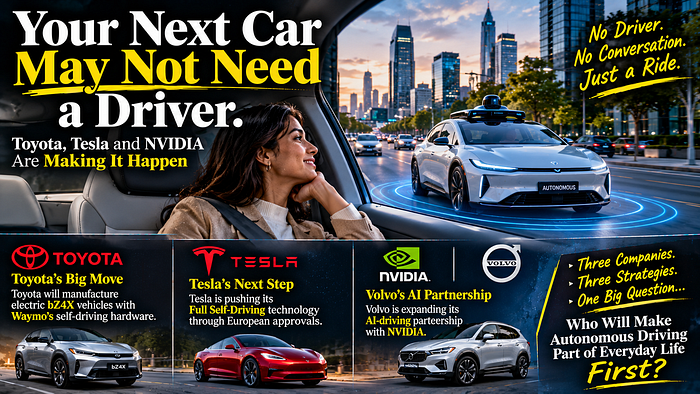
Your Next Car May Not Need a Driver.
Toyota, Tesla and NVIDIA Are Making It Happen Just now Photo by Author > _Self-driving cars are moving beyond futuristic demonstrations._ > > > _Toyota, Waymo, Tesla and NVIDIA are taking different ap...
Toyota, Tesla and NVIDIA Are Making It Happen
Just now
Photo byAuthor
> _Self-driving cars are moving beyond futuristic demonstrations._
>
>
> _Toyota, Waymo, Tesla and NVIDIA are taking different approaches to change how we travel._
Imagine booking a taxi, getting inside, and discovering there’s nobody behind the steering wheel.
No driver. No conversation. Just a car taking you to your destination.
For years, this sounded like science fiction.
But the automotive industry is getting closer to making it an everyday experience.
On October 30, 2026, Toyota and Waymo announced a major expansion of their partnership.
Toyota will manufacture electric bZ4X vehicles with Waymo’s autonomous-driving hardware integrated directly into the production process.
Meanwhile, Tesla is pushing its Full Self-Driving technology through European regulatory approvals, and Volvo is expanding its AI-driving partnership with NVIDIA.
> Three companies.
>
>
> Three different strategies.
>
>
> One enormous question…… Who will make autonomous driving part of everyday life first?
Tesla Is Fighting for Self-Driving Approval in Europe
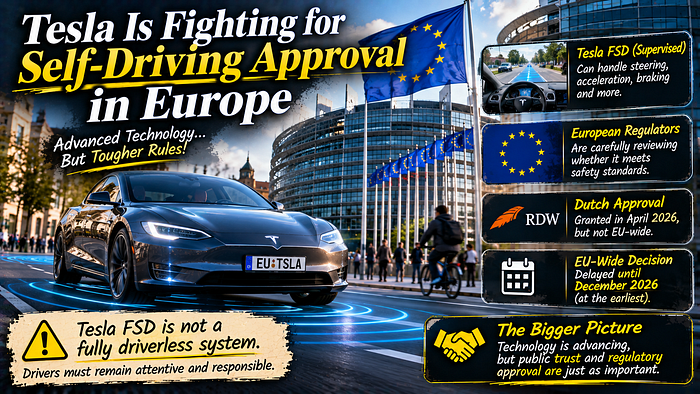
Photo byAuthor
While Toyota and Waymo are preparing robotaxis in Japan, Tesla is facing a different challenge in Europe.
Its Full Self-Driving (Supervised) system can perform many driving tasks, including steering, acceleration, braking, and responding to traffic conditions.
But European regulators have been carefully examining whether the technology meets regional safety requirements.
The Dutch vehicle authority, RDW, granted approval for the supervised system in April 2026.However, this approval does not automatically mean it can operate throughout Europe.
An EU-wide decision was delayed, with December 2026 the earliest apparent opportunity for a vote.
There’s an important distinction…… Tesla FSD is not a fully driverless system.
Drivers must remain attentive and responsible for the vehicle.
The technology may be advancing, but public trust and regulatory approval are just as important as software performance.
NVIDIA Is Becoming a Major Player in AI Cars
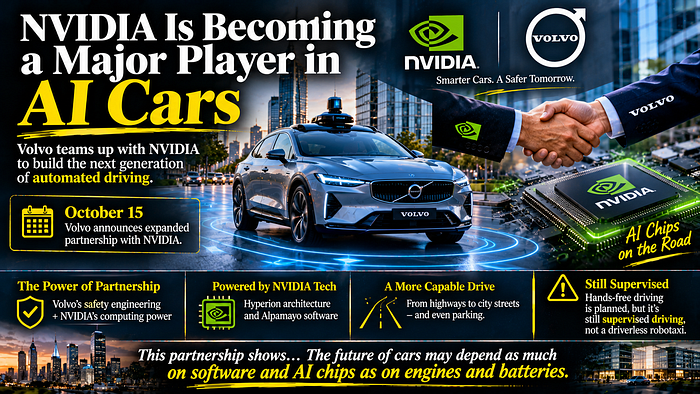
Photo byAuthor
Here’s something interesting: NVIDIA doesn’t need to manufacture a car to influence the future of driving.
On October 15,Volvo announced an expanded partnership with NVIDIA to develop more advanced automated-driving technology.
The collaboration combines Volvo’s safety engineering with NVIDIA’s computing and AI technology.
The system uses NVIDIA’s Hyperion architecture and Alpamayo driving software to help future Volvo vehicles understand roads, recognise situations, and make driving decisions.
The ambition is to support driving from door to door, including highways, busy city streets, and parking situations.
However, the planned hands-free capability is still supervised driving, not a driverless robotaxi.
> This partnership highlights an important development……
>
>
> The future of cars may depend as much on software and AI chips as on engines and batteries.
Not All Self-Driving Cars Are Actually Self-Driving
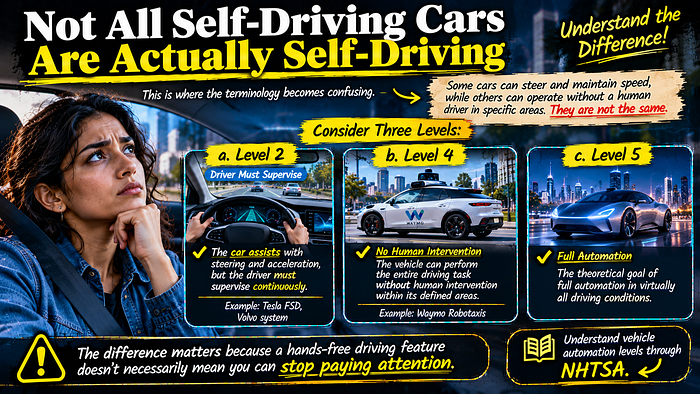
Photo byAuthor
This is where the terminology becomes confusing.
Some cars can steer and maintain speed, while others can operate without a human driver in specific areas.
Get Jeet Laha’s stories in your inbox
Join StartsNest for free to get updates from this writer.
Remember me for faster sign in
They are not the same technology.
Consider three levels:
**a. Level 2**
The car assists with steering and acceleration, but the driver must supervise continuously. Tesla FSD and the Volvo system discussed here fall into this supervised category.
**b. Level 4**
The vehicle can perform the entire driving task without human intervention within its defined operating conditions. Waymo’s robotaxis use this approach.
**c. Level 5**
The theoretical goal of full automation in virtually all driving conditions.
The difference matters because a hands-free driving feature doesn’t necessarily mean you can stop paying attention.
Understand vehicle automation levels through NHTSA.
Why Is Everyone Investing in Autonomous Driving?
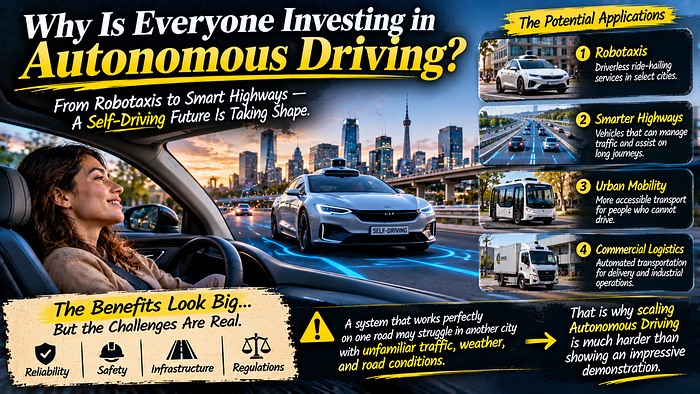
Photo byAuthor
Imagine a delivery company operating hundreds of vehicles.
If autonomous technology can safely handle more driving tasks, businesses could potentially improve fleet efficiency and reduce some repetitive driving work.
The potential applications include
**1. Robotaxis**
Driverless ride-hailing services in selected cities.
**2. Smarter highways**
Vehicles that can manage traffic, maintain distance, and assist with long journeys.
**3. Urban mobility**
More accessible transport for people who cannot drive.
**4. Commercial logistics**
Automated transportation for selected delivery and industrial operations.
But these benefits depend on reliability, safety, infrastructure, and regulations.
A system that works perfectly on one road may struggle in another city with unfamiliar traffic patterns, weather, and road conditions.
That is why scaling autonomous driving is much harder than showing an impressive demonstration.
What Could Happen to the Future of Driving?
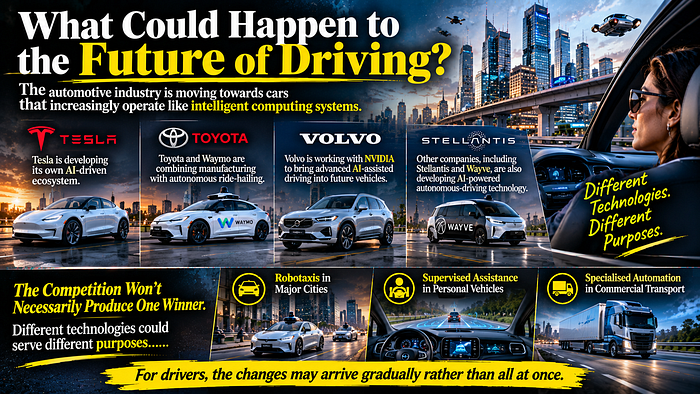
Photo byAuthor
The automotive industry is moving towards cars that increasingly operate like intelligent computing systems.
> Tesla is developing its own AI-driven ecosystem.
>
>
> Toyota and Waymo are combining manufacturing with autonomous ride-hailing.
>
>
> Volvo is working with NVIDIA to bring advanced AI-assisted driving into future vehicles.
>
>
> Other companies, including Stellantis and Wayve, are also developing AI-powered autonomous-driving technology.
The competition won’t necessarily produce one winner.
> Different technologies could serve different purposes……
>
>
> Robotaxis in major cities, supervised assistance in personal vehicles, and specialised automation in commercial transport.
For drivers, the changes may arrive gradually rather than all at once.
The Future of Cars Is No Longer Just About Driving
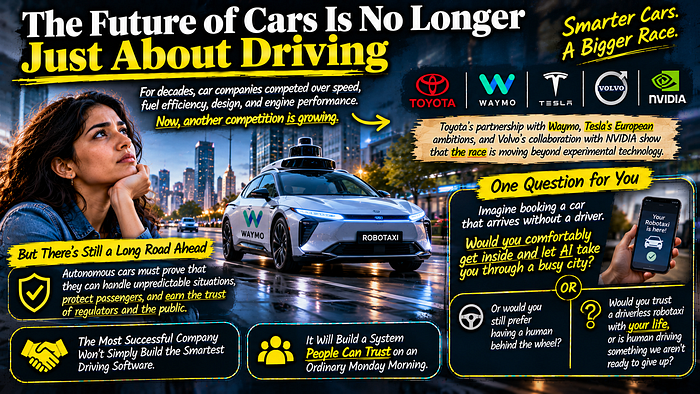
Photo byAuthor
For decades, car companies competed over speed, fuel efficiency, design, and engine performance.
Now, another competition is growing.
> Who can build a car that understands its surroundings, makes safer decisions, and drives with less human intervention?
Toyota’s manufacturing partnership with Waymo,
Tesla’s European ambitions, and Volvo’s collaboration with NVIDIA show that the race is moving beyond experimental technology.
But there’s still a long road ahead.
Autonomous cars must prove that they can handle unpredictable situations, protect passengers, and earn the trust of regulators and the public.
> The most successful company won’t simply build the smartest driving software.
>
>
> It will build a system people can trust on an ordinary Monday morning.
One Question for You
> Imagine booking a car that arrives without a driver.
>
>
> Would you comfortably get inside and let AI take you through a busy city?
>
>
> Or would you still prefer having a human behind the wheel?
>
>
> Would you trust a driverless robotaxi with your life, or is human driving something we aren’t ready to give up?

Jabir Digital
Founder and editor of StartsNest. Technology writer and digital marketing specialist with expertise in mobile technology, consumer electronics, and online business strategies.
View all articles by Jabir Digital →More to read
She Thought Her Hinge Match's Photo Looked Off — Then
A woman discovered her Hinge match used AI to deepfake his face onto other men's photos. Learn how AI is changing online dating, what dating apps are doing about it, and how to protect yourself from AI catfishing.
How to Analyze a MicroSaaS Before You Buy It
Just now A tidy dashboard can hide a shrinking business. Here is how to check the revenue, the code and the customers yourself. A MicroSaaS is a small subscription software product, usually run by one...
Foundation–Architecture Theory of Intelligence (FATI)
1 hour ago Foundation–Architecture Theory of Intelligence (FATI) Evidence-integrated draft. A preliminary theoretical framework, not an established or experimentally validated theory. Summary FATI pro...
Comments (0)
No comments yet. Be the first to share your thoughts!