
Transformer Architectures and Large Language Models: Design, Deployment, and Optimization of…
Transformer Architectures and Large Language Models: Design, Deployment, and Optimization of Enterprise Deep Learning Pipelines Just now Transformers and Large Language Models (LLMs) have significantl...
Transformer Architectures and Large Language Models: Design, Deployment, and Optimization of Enterprise Deep Learning Pipelines
Just now
Transformers and Large Language Models (LLMs) have significantly advanced artificial intelligence by enabling effective natural language understanding, text generation, summarization, and question answering. The Transformer architecture utilizes self-attention, multi-head attention, positional encoding, and feed-forward neural networks to capture contextual relationships among tokens and process sequential data efficiently. Despite these capabilities, deploying LLMs in enterprise environments presents several challenges, including computational cost, inference latency, scalability, data privacy, security, and model reliability. This study explores Transformer architectures and LLMs, focusing on the design and deployment of enterprise deep learning pipelines. It discusses the major stages of the deployment lifecycle, including data ingestion and preprocessing, model selection and fine-tuning, performance evaluation, model serving, continuous monitoring, and maintenance. Furthermore, it examines the integration of Retrieval-Augmented Generation (RAG) to improve access to enterprise knowledge and discusses the role of Machine Learning Operations (MLOps) in automating model management and ensuring reproducibility. Key evaluation criteria, including response accuracy, latency, throughput, resource utilization, and security, are considered for assessing production readiness. The study highlights the importance of integrating scalable infrastructure, robust evaluation mechanisms, and appropriate security and governance controls to develop reliable and cost-effective enterprise AI solutions. The proposed discussion provides a foundation for understanding how Transformer-based models can be integrated into practical enterprise applications through well-structured and maintainable deep learning pipelines.
1. Introduction
Transformers and Large Language Models (LLMs) have become important technologies in modern artificial intelligence. They support applications such as conversational AI, document summarization, question answering, code generation, semantic search, and automated analysis of enterprise documents.
However, developing an accurate deep learning model is only one part of an enterprise AI solution. Organizations must also deploy models reliably, integrate them with business applications, protect sensitive data, monitor performance, control costs, and maintain the system as requirements change.
This topic combines two major areas:
- Transformer architecture and LLMs: how modern language models process text, learn contextual representations, and generate responses.
- Enterprise deployment of deep learning pipelines: how models are prepared, deployed, monitored, secured, and maintained in production environments.
2. Learning objectives
1. Understand the architecture of Transformer models.
2. Explain self-attention, multi-head attention, and positional encoding.
3. Understand the relationship between Transformers and LLMs.
4. Explore the stages of an enterprise deep learning pipeline.
5. Design an end-to-end LLM deployment architecture.
6. Examine deployment, monitoring, security, scalability, and evaluation strategies.
3. What is a Transformer?
A Transformer is a neural network architecture. Earlier sequence models, such as recurrent neural networks (RNNs) and LSTMs, process sequences step by step. Transformers use attention mechanisms to model relationships between tokens, allowing many token representations to be processed in parallel during training.
A token is a unit of text processed by the model. Depending on the tokenizer, it may represent a whole word, part of a word, punctuation, or another text segment.
For example, consider the sentence:
> _Artificial intelligence is transforming healthcare._
A tokenizer might convert this sentence into tokens such as:
`["Artificial", "intelligence", "is", "transforming", "healthcare", "."]`
The actual tokenization depends on the model.
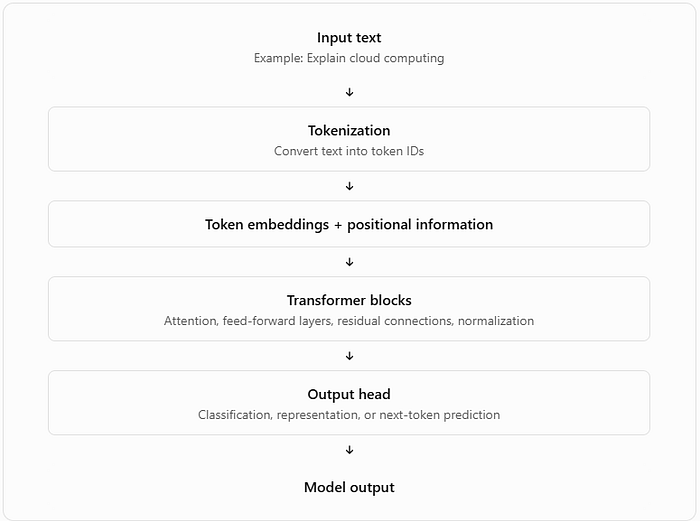
The Transformer converts tokens into numerical representations, processes relationships between them using attention layers, and produces contextual representations that support tasks such as prediction, classification, and text generation.
4. Transformer architecture
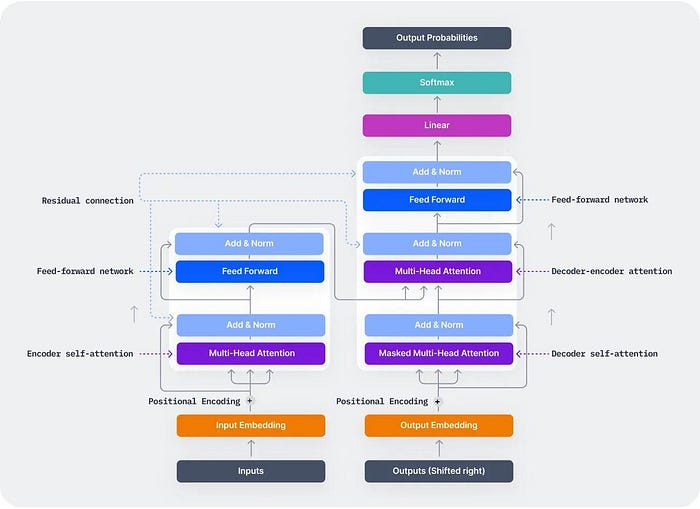
A standard Transformer was originally designed with an encoder and a decoder. Modern Transformer-based models use different configurations depending on their intended tasks.
4.1 Overall Transformer workflow
4.2 Token embeddings
Neural networks operate on numbers, so text tokens must be mapped to vectors.
Suppose the token “cloud” is represented by a vector of dimension 512:

A token embedding layer learns or retrieves a vector for each token ID. These initial embeddings are then transformed by the Transformer layers.
4.3 Positional information
Attention by itself does not inherently encode the order in which tokens occur. Transformers therefore incorporate positional information.
For example:
- “The model trains the network.”
- “The network trains the model.”
The same words can express different meanings when their order changes.
Original Transformers use sinusoidal positional encodings, while many modern models use learned positional embeddings or rotary positional embeddings (RoPE).
4.4 Self-attention
Self-attention allows each token to gather information from other tokens in the sequence.
Consider:
> _The server rejected the request because it was invalid._
The model needs to associate “it” with the relevant part of the sentence. Attention provides a mechanism for assigning different weights to other tokens when constructing a contextual representation.
For an input representation matrix _X_, the model computes queries _Q_, keys _K_, and values _V_:

Scaled dot-product attention is:

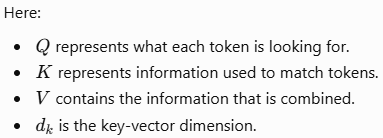
The softmax function converts the attention scores into weights, and the weighted values form the output representations.
4.5 Multi-head attention
Instead of performing attention only once, multi-head attention uses multiple attention heads. Each head can learn different relationships between tokens.
For example, different heads may learn to emphasize:
- Relationships between subjects and verbs.
- Connections between pronouns and their referents.
- Associations between technical terms.
- Relationships between nearby or distant tokens.
The head outputs are concatenated and projected into a combined representation.
4.6 Feed-forward network
After attention, each token representation passes through a feed-forward neural network. This usually contains linear transformations and nonlinear activation functions.
A simplified representation is:


4.7 Residual connections and layer normalization
Transformer blocks commonly use residual connections and normalization to improve optimization and stabilize training.
A simplified residual operation is:

The exact ordering of normalization, attention, and residual operations depends on the architecture.
5. Types of Transformer architectures
Not every Transformer is a text-generating LLM. The architecture is selected according to the task.
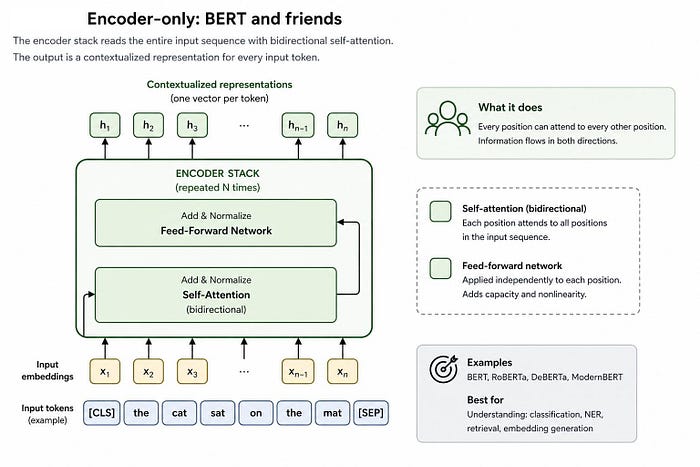
Encoder-only models
Learn contextual representations by processing input tokens. Commonly used for text classification, semantic representations, and named entity recognition.
Example: BERT.
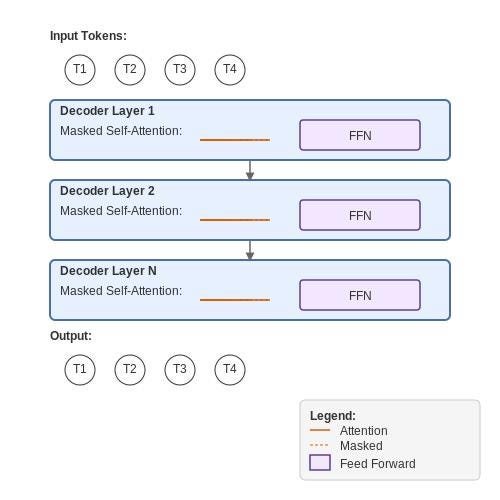
Decoder-only models
Predict the next token using preceding tokens. Commonly used for conversational AI, text generation, code generation, and general-purpose LLMs.
Example: GPT.
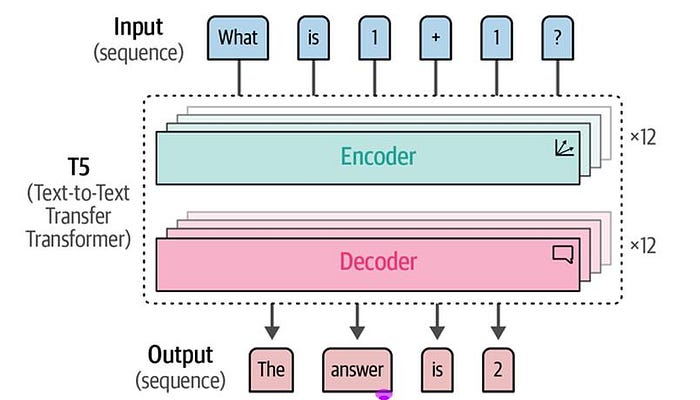
Encoder-decoder models
Encode an input sequence and generate an output sequence. Useful for translation, summarization, and other sequence-to-sequence tasks.
Example: T5.
6. What are Large Language Models (LLMs)?
An LLM is a language model trained on large amounts of text and other suitable data to learn patterns that support language understanding and generation. Many modern LLMs are built using decoder-only Transformer architectures, although LLMs can use other architectures too.
A typical LLM development lifecycle includes:
1. Pretraining: learn general language patterns, often by predicting missing or subsequent tokens.
2. Instruction tuning: train the model to follow instructions and respond in a useful format.
3. Preference or alignment training: optionally optimize responses using human or model-generated preferences.
4. Inference: use the trained model to generate outputs for user requests.
The model learns statistical relationships in its training data. It does not automatically guarantee factual correctness, reliable reasoning, or access to current information.
6.1 How an LLM generates text
Suppose a user enters:
> _What are the benefits of cloud computing?_
The input is tokenized and passed through the model. The model calculates probabilities for possible next tokens, selects a token according to its decoding strategy, and repeats the process until it produces a response or reaches a stopping condition.
This process is called autoregressive generation in decoder-only models.
6.2 Important LLM parameters
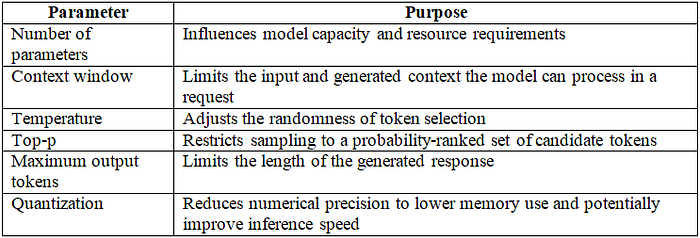
Increasing model size does not automatically produce better results for every enterprise task. Model selection should consider task quality, latency, cost, security, and deployment constraints.
7. Enterprise deployment of deep learning pipelines
An enterprise deep learning pipeline is an end-to-end system that moves a model from experimentation into reliable production use.
It includes more than model training. It also covers data ingestion, validation, versioning, deployment, monitoring, access control, and ongoing improvement.
7.1 Enterprise AI deployment architecture
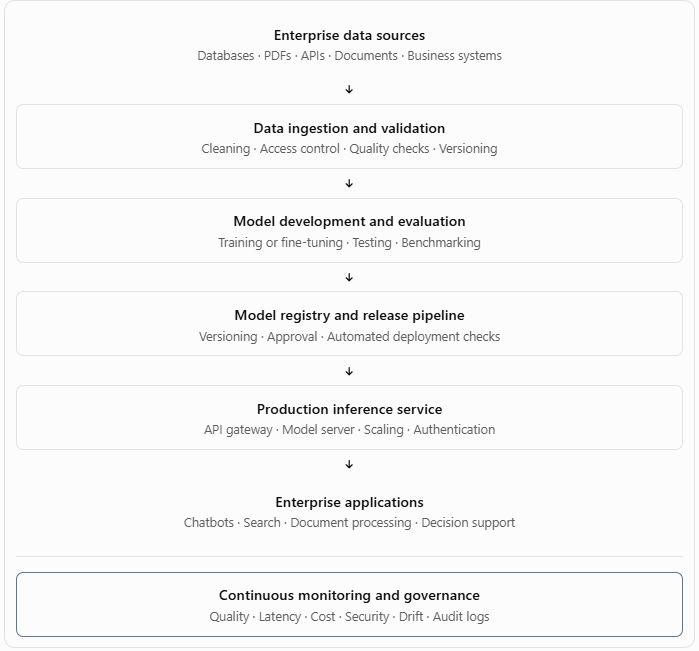
The monitoring and governance layer spans the entire lifecycle. Production feedback can inform future evaluation and retraining, but model updates should pass through controlled testing and approval before release.
Get Vijay Dasari’s stories in your inbox
Join StartsNest for free to get updates from this writer.
Remember me for faster sign in
7.2 Major pipeline stages
Stage 1: Data ingestion
Enterprise data may come from relational databases, document repositories, APIs, application logs, and other approved sources. The pipeline collects only the data needed for the intended use and applies appropriate permissions.
Stage 2: Data preprocessing
Tasks include:
- Removing corrupted or duplicate records.
- Validating schemas and data types.
- Cleaning and normalizing text.
- Splitting training, validation, and test datasets.
- Detecting sensitive information where appropriate.
- Recording dataset versions and lineage.
Stage 3: Model development
The team selects an appropriate model, establishes a baseline, and conducts training or fine-tuning. For many enterprise applications, using a pretrained model with retrieval-augmented generation (RAG) may be more practical than training an LLM from scratch.
Stage 4: Evaluation and validation
Evaluate the model using representative data before deployment. Testing should include normal requests, edge cases, adversarial prompts, sensitive-data scenarios, and failures of dependent systems.
Stage 5: Packaging and release
Package the model, its dependencies, configuration, preprocessing code, and evaluation results into a versioned release. Automated tests should prevent a model from being deployed if it fails defined quality or security criteria.
Stage 6: Production serving
Expose the model through an authenticated API or an application service. A deployment may use cloud infrastructure, on-premises servers, managed model endpoints, or a hybrid arrangement.
Stage 7: Monitoring and maintenance
Monitor service availability, response quality, latency, token consumption, infrastructure usage, errors, and changes in the input data. Retraining or replacing the model should be based on evidence and controlled validation.
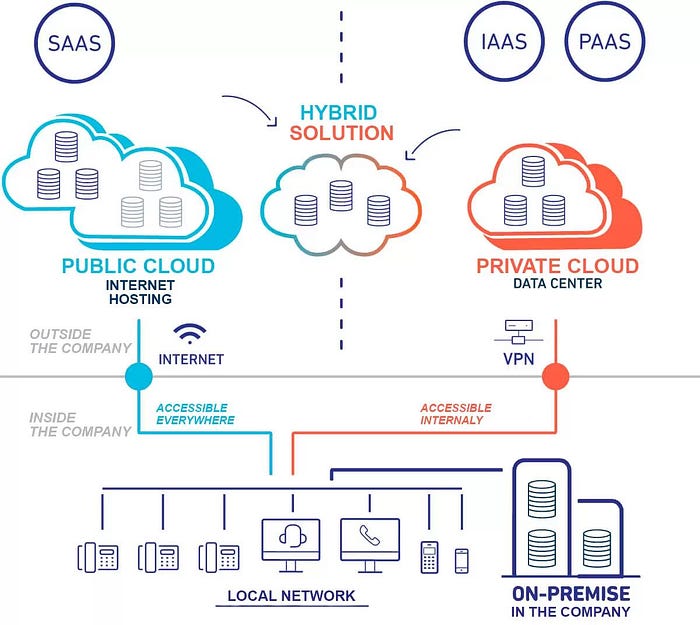
8. Enterprise LLM deployment patterns
Organizations can deploy LLM-powered applications in several ways.
1. Cloud-hosted model
A managed service or cloud-hosted model endpoint handles inference. This can simplify scaling and infrastructure management, although cost, data residency, and service dependencies must be assessed.

2. On-premises deployment
The organization operates the model on its own infrastructure. This offers more control over the environment and data handling but requires suitable hardware, operations expertise, and security maintenance.

3. Hybrid deployment
Sensitive workloads may remain in a controlled environment while other workloads use external services. The design must explicitly define data flows, trust boundaries, and routing rules.
8.1 Model serving and scaling
An enterprise inference service commonly includes:
- API gateway: authenticates callers, applies rate limits, and validates requests.
- Model server: loads the model and performs inference.
- Request queue: manages bursts of incoming requests.
- Batching: combines compatible requests to improve hardware utilization.
- Autoscaling: adjusts resources according to load and capacity.
- Caching: reuses suitable results where safe and appropriate.
For large language models, techniques such as continuous batching, key-value (KV) caching, and quantization can improve serving efficiency. The choice depends on the model, hardware, request lengths, concurrency, and quality requirements.
9. RAG in enterprise LLM applications
A common enterprise requirement is to answer questions using internal documents without retraining an LLM every time the documents change.
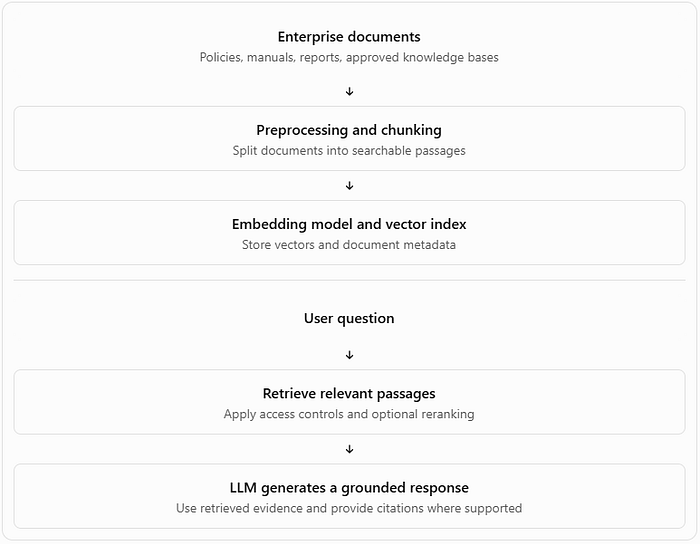
Retrieval-Augmented Generation (RAG) combines document retrieval with language generation.
Example: Enterprise policy assistant
An employee asks:
> _What is the organization’s travel reimbursement policy?_
The system retrieves authorized policy passages, includes relevant content in the prompt, and asks the LLM to produce an answer grounded in those passages.
A production system should:
1. Enforce document permissions during retrieval.
2. Preserve document source and version information.
3. Cite supporting passages when the application requires traceability.
4. Handle missing or conflicting evidence.
5. Avoid generating unsupported policy details.
RAG improves access to current organizational information, but it does not guarantee factual correctness. Retrieval quality, document quality, access controls, and response validation remain essential.
10. Tools and technologies for enterprise deployment
The following are representative technology choices, not a requirement to use every tool.
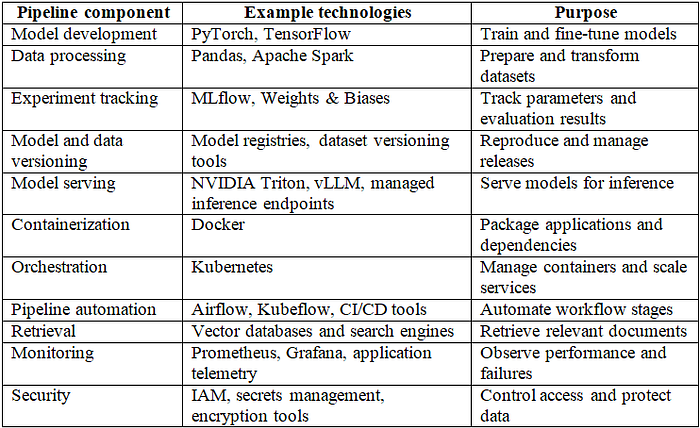
The appropriate stack depends on the organization’s infrastructure, compliance requirements, engineering skills, and expected workload.
11. Security and governance
Deploying an LLM in an enterprise environment introduces risks beyond ordinary model-serving concerns.
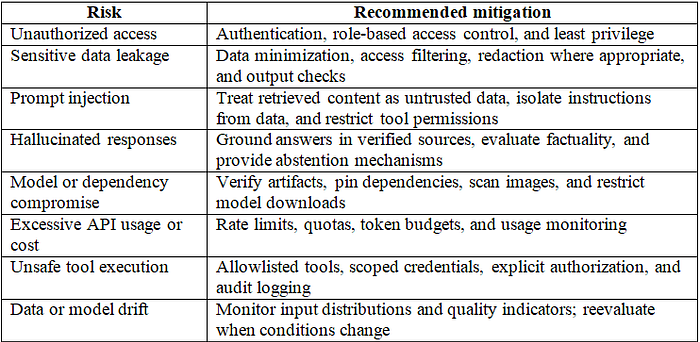
Security must be applied across the full lifecycle, from data collection to model retirement. A prompt filter alone is not a complete defense against prompt injection or data leakage.
12. Model evaluation and production monitoring
An enterprise LLM pipeline should measure both model quality and system performance.
Model quality
Accuracy where applicable, task success rate, groundedness, relevance, completeness, and human evaluation.
Performance
Latency, throughput, requests per second, token generation speed, and timeout rate.
Cost and resource utilization
Cost per request, input/output tokens, GPU utilization, memory usage, and storage costs.
Reliability and safety
Error rate, policy violations, unauthorized-access attempts, and sensitive-data exposure indicators.
For latency, teams often track the 95th percentile (p95) and 99th percentile (p99), rather than relying only on average response time. These measurements reveal slow requests that may affect user experience.
For a RAG system, additional metrics include retrieval Recall@k, ranking quality, citation correctness, and whether the generated response is supported by the retrieved evidence.
13. A practical enterprise deployment example
Consider an organization that wants to build an internal AI assistant for answering questions about technical documentation.
A feasible implementation plan is:
1. Data preparation: collect approved technical documents and record access permissions.
2. Index construction: extract text, split it into chunks, generate embeddings, and build a searchable index.
3. Model selection: choose an LLM based on quality, latency, cost, and data-handling requirements.
4. Application development: build a retrieval and generation service with an authenticated API.
5. Evaluation: test answer correctness, retrieval relevance, citations, unauthorized requests, and prompt injection.
6. Deployment: package the service, deploy it in the chosen environment, and configure scaling and access controls.
7. Monitoring: track latency, errors, resource use, response quality, and user feedback.
8. Continuous improvement: update the document index as approved content changes and deploy model or prompt updates only after testing.
The first version should be limited to a defined set of documents and read-only tasks. This reduces complexity and makes it easier to establish measurable acceptance criteria before expanding the system.
14. End-to-end MLOps lifecycle
The enterprise deployment process can be summarized as follows:
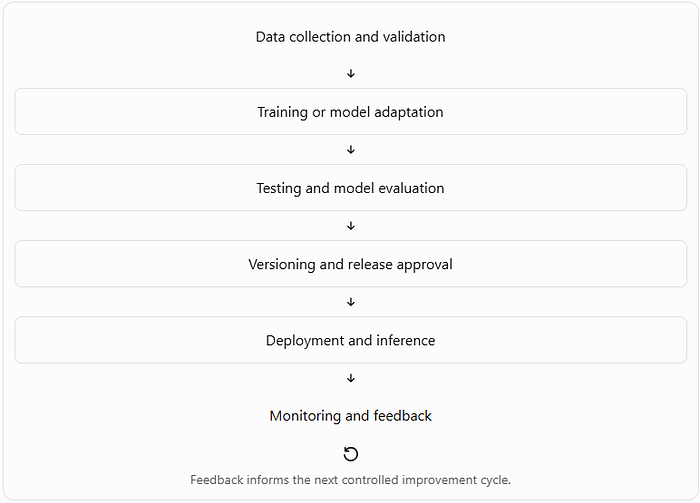
MLOps applies engineering practices to machine-learning development and operations. For LLMs, this often expands to include prompt versioning, retrieval-index management, evaluation datasets, safety tests, and model-serving optimization.
15. Challenges in enterprise deployment
Common challenges include:
- High computational requirements: large models may require significant GPU memory and compute.
- Latency: long input contexts and generated responses can increase response times.
- Data quality: incomplete, outdated, or contradictory documents can lead to poor results.
- Hallucinations: fluent responses may contain unsupported information.
- Scalability: concurrent users and variable workloads complicate resource allocation.
- Model drift: changing data or business requirements can reduce performance.
- Compliance: data residency, privacy, auditability, and retention requirements affect architecture decisions.
- Operational complexity: model, application, retrieval, and infrastructure versions must remain compatible.
A good deployment strategy balances model quality against measurable business requirements rather than optimizing model size alone.
16. Conclusion
Transformer architecture provides the foundation for many modern LLMs through token embeddings, attention mechanisms, feed-forward networks, and deep contextual representations. LLMs use these representations to perform language-related tasks, including text generation, summarization, and question answering.
Enterprise deployment extends this capability into a production system through data pipelines, model evaluation, versioning, serving infrastructure, security controls, monitoring, and continuous improvement. For document-oriented enterprise applications, combining an LLM with RAG can provide access to organizational knowledge without requiring full model retraining whenever documents change.
Summary: successful enterprise AI depends not only on choosing a capable Transformer or LLM, but also on building a secure, measurable, scalable, and maintainable pipeline around it.
Frequently Asked Questions
What is Transformer Architectures and Large Language Models: Design, Deployment, and Optimization of… about?
Transformer Architectures and Large Language Models: Design, Deployment, and Optimization of Enterprise Deep Learning Pipelines Just now Transformers and Large Language Models (LLMs) have significantl...
Which category does this article belong to?
This article is part of our Usb Cable collection on StartsNest.
Is this content free to read?
Yes, all articles on StartsNest are free to read. No registration required.

Maya Okonkwo
Maya Okonkwo is a technology writer and digital marketing specialist with over 6 years of experience covering mobile technology, consumer electronics, and online business strategies. She holds a degree in Communications and has contributed to multiple tech publications. Her expertise includes mobile phone reviews, EMI financing guides, and digital commerce trends in South Asia.
View all articles by Maya Okonkwo →More to read
The Danger of the Brilliant Generalist (North Mondays Series • Episode 185)
Just now Why trying to be good at everything is the fastest route to being remembered for nothing The Danger of the Brilliant Generalist In January 2026, Indeed Hiring Lab data showed that 53% of all ...
Google Colab (Google Colaboratory) adalah layanan berbasis cloud dari Google yang memungkinkan Anda…
Google Colab (Google Colaboratory) adalah layanan berbasis cloud dari Google yang memungkinkan Anda menulis dan menjalankan kode Python langsung melalui browser tanpa perlu menginstal aplikasi apa pun...
New to Physical AI? Here Are 8 Terms You Should Know
Just now We’ve taught AI to write, draw, and answer questions. I work in a field where engineers are teaching it to interact with the physical world. Think about something as simple as picking up a cu...
Comments (0)
No comments yet. Be the first to share your thoughts!